Top 12 B2B Content Marketing Strategies for AI-Driven Search
Buyers have moved beyond simple Google searches to asking ChatGPT for vendor recommendations and using Perplexity to compare solutions. They expect AI to surface exactly what they need before visiting websites, which means traditional B2B content marketing strategies require a fundamental rethink. The rules that governed search visibility for the past decade are being rewritten as AI systems reshape how decision makers discover and evaluate solutions.
Companies don't need to abandon everything that's working, but they do need to align their content strategy with how AI systems understand, evaluate, and recommend solutions. Success requires structuring thought leadership content, case studies, and educational resources so they become the trusted sources AI platforms cite when ideal customers seek help. Trailblazer Marketing's solution helps B2B companies rank number 1 on Google and AI search by adapting content strategies for this new landscape.
Summary
Zero-click searches now account for 60% of all Google queries, according to Data Axle's 2026 research. Your content gets extracted, summarized, and presented to buyers without attribution or traffic flowing back to your site. Ranking number one on Google no longer guarantees visibility when AI systems bypass your page entirely to synthesize answers from multiple sources.
Traditional pipeline attribution breaks down when buyers consume your thought leadership through AI-generated summaries rather than direct website visits. Demand Gen Report's 2026 study found that 70% of B2B buyers consume three to five pieces of content before engaging with sales, but those consumption patterns now occur within AI interfaces, making tracking impossible. The metrics that justified content budgets for the past decade suddenly feel unreliable.
Most B2B content fails in AI search because it lacks the structural clarity these systems need for retrieval and citation. Legacy SEO thinking still dominates strategy, with teams optimizing for rankings instead of retrieval probability. When buyers research solutions inside ChatGPT or Perplexity, those systems prioritize content with clear authority signals, consistent brand mentions across trusted sources, and information structured for extraction rather than just readability.
Entity-based SEO builds repeated semantic associations between your brand and specific buyer problems. Omnibound's 2026 analysis of 47+ data points on buyer behavior found that brands establishing clear entity relationships in their content architecture see measurably higher citation rates in AI-generated answers. LLMs don't think in keywords; they think in entities (brands, products, concepts) and the relationships between them.
Original research and industry reports create citable sources that LLMs reference when answering complex questions. Content Marketing Institute's 2024 research analyzing 215,000+ content marketers found that organizations producing original research see measurably higher brand recognition and citation rates across both traditional and AI search channels. Publishing data on industry benchmarks or common failure points makes your content part of how LLMs inform prospects researching those topics.
This is where rank number 1 on Google and AI search fits in, helping B2B companies structure content so it performs in both traditional search rankings and AI-driven retrieval systems, where buying decisions increasingly happen.
Does B2B Content Marketing Still Work in the Age of AI Search and Zero-Click Results?
Most B2B marketers still believe content marketing follows the same playbook: publish thought leadership, rank on Google, drive traffic to your site, and convert visitors through gated assets or email nurture sequences. That model is breaking down faster than most teams realize.
🚨 Warning: The traditional content-to-conversion funnel is becoming ineffective as AI search and zero-click results dominate the digital landscape.
"The shift toward zero-click searches means that 50% of Google searches now end without a click to another website." — SparkToro Research, 2023
💡 Key Insight: B2B content strategies must evolve beyond the publish-and-pray approach to remain competitive in an AI-driven search environment.

The Visibility Architecture Shifted
AI search platforms like ChatGPT, Perplexity, and Gemini now answer buyer questions without sending clicks to your website. According to Data Axle's 2026 research, 60% of Google searches result in zero clicks. Your content gets extracted, condensed, and displayed to potential buyers without attribution or traffic back to your site. Content now exists in two states: found through regular search, and taken by AI systems that compress your ideas into responses buyers read without visiting your website. Teams optimized for rankings find organic traffic declining despite publishing more content than ever.
Where Traditional Metrics Break Down
Pipeline attribution becomes impossible when thought leadership influences buyers through AI-generated summaries rather than direct website visits. Demand Gen Report's 2026 study found that 70% of B2B buyers consume three to five pieces of content before engaging with sales, yet those consumption patterns now occur inside AI interfaces, where tracking breaks down completely. Content ROI gets questioned at the leadership level because traditional analytics cannot measure influence beyond owned properties.
How does AI content surfacing impact measurement accuracy?
Teams watch their best case studies and product comparisons appear in AI answers without tracking which prospects saw that content or how it influenced their shortlist. The metrics that justified content budgets for the past decade now feel unreliable.
The Real Problem Isn't AI
Content didn't stop working—most B2B content isn't set up for AI to find, quote, or use to influence decisions. Teams still prioritize high rankings over retrieval probability, and few understand how large language models select, compress, and present information when buyers seek recommendations.
How do AI systems prioritize content for buyer research?
When buyers search for solutions inside ChatGPT or Perplexity, those systems prioritize content with clear authority signals, consistent brand mentions across trusted sources, and information structured for extraction. Your blog posts might rank well, but without citations in community discussions, references in industry publications, or semantic clarity for AI systems, they become invisible in the spaces where buying decisions increasingly occur.
What solutions help B2B companies adapt to AI optimization?
Solutions like Trailblazer Marketing's LLM SEO services help B2B companies adapt by combining traditional SEO fundamentals with AI-specific optimization. Our services teach teams to organize content for both Google rankings and AI visibility, building the authority signals and citation patterns that ensure discoverability across platforms.
The New Content Operating System for AI Search
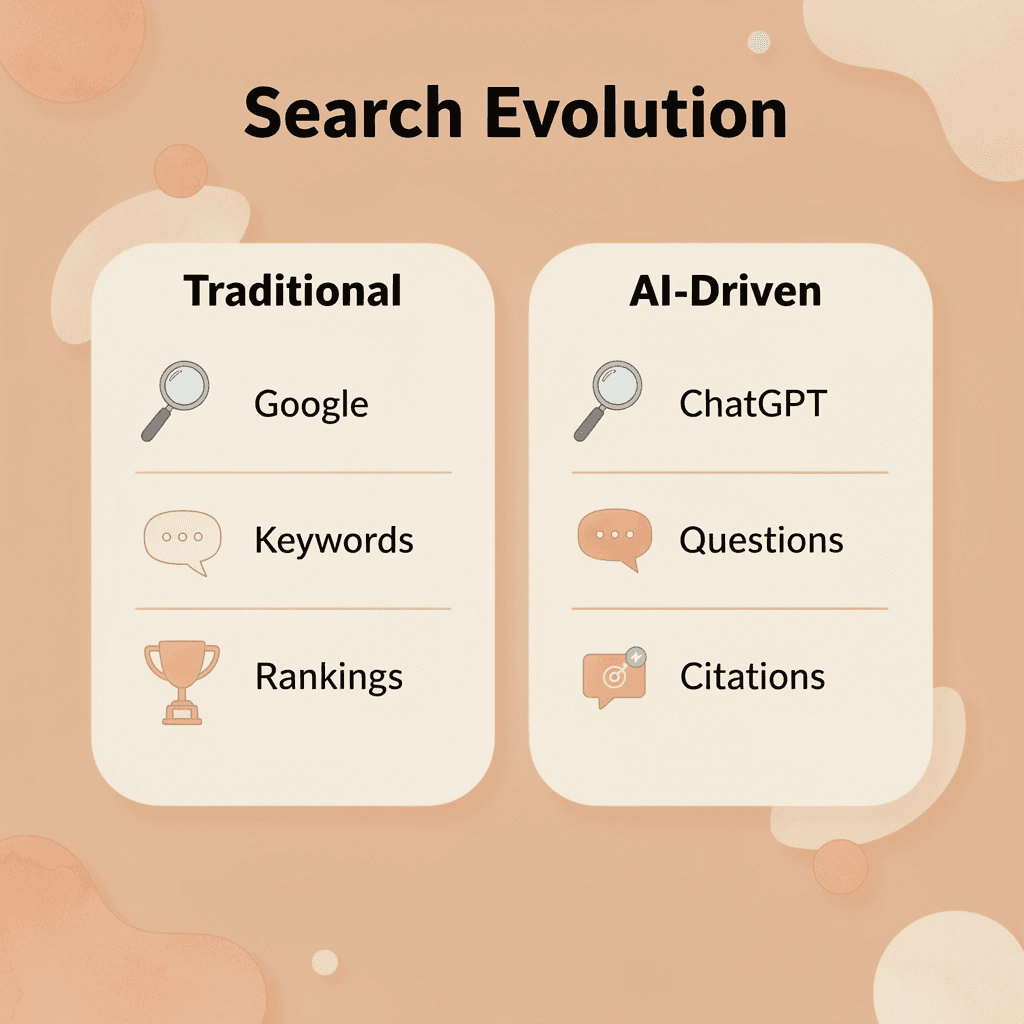
B2B content marketing isn't "changing tactics." It's shifting operating systems. For the past decade, SEO worked like this: Keyword targeting → ranking pages → click-through traffic → tracked conversions. But AI search breaks that chain at the middle step. Platforms like ChatGPT and Perplexity don't send users to your site first—they pull, compress, and repackage your content directly into answers. This creates a different system: Retrievability → Entity recognition → Citation probability → Decision influence.
Step 1: If content is extracted, not clicked → clarity becomes more important than depth
AI systems don’t reward the buildup of storytelling. They reward immediate, structured answers that can be lifted cleanly.
→ This is why retrieval-optimized structuring exists.
Step 2: If AI decides what gets surfaced → entities matter more than keywords
Search engines ranked pages. AI systems recognize relationships between brands, problems, and concepts.
→ This is why entity-based SEO is required.
Step 3: If buyers ask comparative questions → missing comparison content = instant invisibility
AI answers “best,” “vs,” and “alternatives” queries directly.
If you don’t explicitly own those comparisons, you are excluded from the decision layer.
→ This is why BOFU comparison content is mandatory.
Step 4: If AI summarizes the web → isolated content loses authority
LLMs don’t trust single pages—they infer expertise from clusters of consistent, interconnected content.
→ This is why topical authority clusters replace standalone blogs.
Step 5: If retrieval replaces browsing → every piece of content must function independently
No guaranteed journey. No sequential reading.
Every paragraph must be:
understandable in isolation
quotable without context
valuable as a standalone answer
→ This is why citation-designed content matters.
The Core Shift
Old SEO assumed: “If we rank, users will come to us.” AI search assumes: “If we are the best source, the system will bring our answer to the user—even if they never visit us.” That means content is no longer competing for clicks. It is competing for selection by AI systems as the default explanation of your category. The question in 2026 isn't whether content marketing works, but whether your content is even eligible to be surfaced by AI systems or ignored entirely because it lacks the structural and authority signals these platforms require.
Related Reading
12 B2B Content Marketing Strategies That Actually Work in AI Search-Driven Buyer Journeys
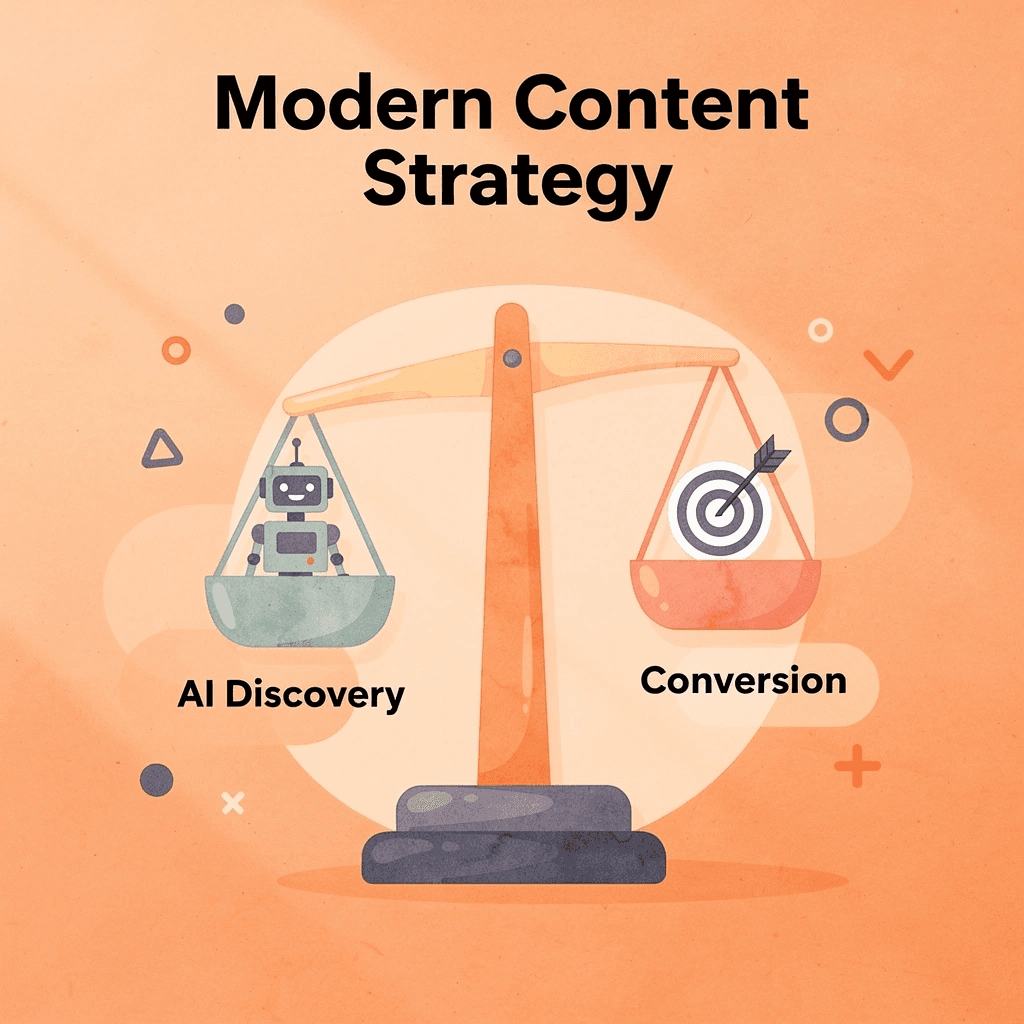
Modern B2B content marketing must be built for AI retrieval and citation. Structure every piece so that AI systems can understand it, share it where large language models learn from, and connect it directly to sales results. The strategies that work answer one question: Does this increase how often AI search finds us and move prospects closer to making a purchase?

🎯 Key Point: The fundamental shift in B2B content strategy is to optimize for both AI discoverability and conversion acceleration.
"AI-optimized content that directly connects to sales outcomes represents the new standard for B2B marketing effectiveness in the modern buyer journey."
💡 Tip: Every piece of content you create should pass the AI citation test - can an AI system easily extract, understand, and reference your key insights when prospects ask related questions?
1. AI Retrieval-Optimized Content Structuring
Answer the question in the first 150 words, not after context or buried in paragraph three. Place it at the top in clear language an LLM can extract and cite without interpretation.
Why do AI systems prioritize direct answers over keyword density?
AI systems reward clarity over keyword density. When ChatGPT or Perplexity scans your content, they look for direct answers formatted as standalone units: answer-first paragraphs, semantic chunking that breaks complex ideas into discrete sections, and explicit statements instead of narrative buildup. Content that "dances around the question" fails in AI retrieval: systems skip it. Competitors who restructure posts to answer directly in the opening lines get cited. You don't.
How does semantic chunking make content more accessible to AI?
Semantic chunking means organizing content so each section answers one sub-question completely. Use descriptive subheadings, write topic sentences that work as standalone answers, and structure paragraphs so the first sentence could stand alone as a quote. This makes your expertise accessible to the systems that now mediate buyer research.
2. Entity-Based SEO
Large language models don't think in keywords. They think in entities: brands, products, people, concepts, and the relationships between them. If your brand isn't consistently connected with specific problems, use cases, or outcomes in the training data these systems consume, you won't appear when prospects ask decision-stage questions.
How do you build semantic associations with your brand?
Entity-based SEO means building repeated connections between your brand and specific problems you solve. Name your product alongside competitor choices and use consistent language across all content so AI language models learn to associate your brand with certain buyer needs. According to Omnibound's 2026 B2B content marketing research, brands that establish clear entity relationships in their content structure see higher citation rates in AI-generated answers.
Why does consistent entity referencing matter for visibility?
When prospects ask ChatGPT "what's the best solution for X," the system recommends brands it has learned to associate with X based on repeated mentions in context. If your content never clearly connects your brand to buyers' problems through consistent entity references, you remain invisible, regardless of traffic volume.
3. Bottom-of-Funnel Comparison Content
Buyers researching alternatives don't visit your homepage. They ask AI tools "X vs Y" or "best Z for [use case]." If you don't own that comparison content, your competitors will.
How do you create effective comparison content?
Make dedicated pages for every "[Your Product] vs [Competitor]" question that prospects search for. Build "best [category] for [specific use case]" content addressing what buyers seek. Include comparison tables with competitor names, feature breakdowns, and clear recommendations for different situations. Teams that check where their brand appears in AI responses compared to competitors often find they're missing from bottom-funnel queries entirely, despite showing up well at the top of the funnel. This gap costs them potential sales.
Why does comparison content work so effectively?
Comparison content works because it matches how people research now. They ask Perplexity or ChatGPT to synthesize comparisons instead of visiting multiple websites. If your brand isn't included in that synthesis because you lack source material, you've eliminated yourself from consideration before the sales conversation begins.
4. Programmatic Content Built for Long-Tail AI Queries
Long-tail queries drive AI search volume. Prospects ask specific questions: "how to [solve problem] when [constraint] without [undesired outcome]." Programmatic content lets you address thousands of these variations systematically, rather than manually writing each one.
How do you build content templates for query variations?
Build content templates around common query structures in your category. Use data to populate variations based on use case, industry, company size, or technical environment. When someone asks a detailed, context-specific question, your content is structured to answer it. Programmatic approaches scale coverage of long-tail queries that individually generate low volume but collectively represent significant buyer research activity.
What's the key to maintaining quality at scale?
The execution challenge is maintaining quality while producing high volumes of content. Programmatic content that reads as a template gets ignored by both AI systems and human readers. The real advantage comes from identifying the core structure of questions your buyers ask in your field, then creating systematic content that answers each variation with specificity.
5. Topical Authority Clusters Instead of Standalone Blogs
Publishing isolated blog posts doesn't build topical authority. Large language models recognize expertise through interconnected content that comprehensively covers a subject from multiple angles.
How do you structure content clusters effectively?
Organize your content in clusters: a main page covering a broad topic, surrounded by supporting pages that explore specific subtopics in depth. Link them together with internal links that show how the topics relate. When AI systems crawl your site, they recognise the cluster structure and understand that you have deep expertise on the subject. A single post about "email marketing" doesn't demonstrate authority. But twenty connected pieces covering segmentation, deliverability, automation workflows, compliance, analytics, and platform comparisons do.
Why do topical clusters improve AI citations?
Topical clusters improve how LLMs cite your content. When multiple pages address related parts of a buyer's question, AI systems pull from the most relevant piece while recognizing the broader authority context. Citations carry more weight because they're backed by depth, not a single article.
6. Content Designed for Citation in AI Answers
AI systems extract content they can easily find and use. Write sections as clear, standalone ideas that make sense independently, without requiring information from other parts of the text. Organize important points into short paragraphs that answer specific questions in 2-3 sentences. Clearly show where your information comes from. Avoid confusing pronoun references that require readers to consult earlier text. When using quotes to answer questions, ensure they stand on their own and make sense without the original context. Each paragraph should be self-contained; any single paragraph could serve as someone's first exposure to the summary. If readers must read three paragraphs to understand your main point, AI systems will skip it and use sources that answer the question immediately.
7. Use-Case Driven Landing Pages Tied to Product Outcomes
Generic product pages don't convert prospects researching specific problems. Landing pages built around use cases address the exact situation someone is trying to solve and connect it directly to how your product delivers that outcome.
How do you structure effective use-case pages?
Build pages around the jobs buyers are trying to accomplish: "revenue attribution for multi-touch B2B campaigns," "compliance reporting for distributed teams," "onboarding automation for high-volume hiring." Each page should frame the use case, explain why current approaches fall short, and demonstrate how your product addresses it with specific features and supporting evidence. Case studies work because they position your customer as the protagonist solving a problem your audience recognizes.
Why do use-case pages perform better in AI search?
Use-case pages perform well in AI search because they match buyer intent. When someone asks "how to solve X," AI tools surface content that directly answers X, rather than general product marketing. These pages also drive demos and trials by helping potential customers determine whether your solution fits their specific situation before engaging sales.
8. Distribution Beyond Google
Large language models train on content from across the web. If your content only lives on your blog, you're missing the platforms where AI models learn to recognize and recommend brands.
Which platforms should you prioritize for AI visibility?
Share your content on LinkedIn, Reddit, YouTube, and industry forums where your buyers seek information and where AI systems gather training data. When you post a detailed answer on Reddit that helps someone solve a problem, that contribution becomes part of the information AI systems use to assess your authority. When you share insights on LinkedIn that spark meaningful conversations, those signals help LLMs understand your relevance.
How does distribution create third-party validation?
Distribution creates the third-party mentions and external validation that LLMs place a high value on. AI systems aggregate what others say about you, where your brand appears in community discussions, and how you're referenced across the web. Narrow distribution limits these signals.
9. Internal Linking Designed for Semantic Reinforcement
Internal links are semantic signals that teach AI systems how concepts on your site relate to each other.
How should you structure internal links for AI understanding?
Use descriptive anchor text to link related content together, showing how different topics on your site connect. When you mention an idea covered elsewhere on your site, link to it with anchor text that tells readers what they'll find. This creates a map of meaning that helps large language models understand how your content is organized and what topics you cover. Strategic internal linking also spreads authority throughout your site, helping deeper pages appear in AI search results.
What internal linking patterns should you avoid?
The pattern that fails is linking for SEO hierarchy without considering how those connections share meaning. Link because the connection adds context, not to pass PageRank. When AI systems crawl your site, they're building a knowledge graph of how your content fits together. Internal linking either clarifies or obscures that structure.
10. Conversion-Layer Content
Content that captures attention doesn't always drive decisions. Conversion-layer content bridges research and commitment, moving prospects from "this is interesting" to "I need to try this."
How do you create content that drives commitment?
Create content that helps sell demos, trials, and consultations by addressing specific concerns that prevent commitment. This includes ROI calculators, implementation guides, comparison tools, and detailed walkthroughs of the post-signup process. The goal is to reduce perceived risk and difficulty while increasing confidence that your solution fits their situation. Readers should feel ready to commit, not merely informed about the category.
Why does conversion-layer content work in AI-driven buyer journeys?
Conversion-layer content works in AI-driven buyer journeys because prospects research extensively before contacting sales. They want to learn independently so a demo confirms their understanding rather than introduces new concepts. Content that builds this confidence accelerates the sales pipeline, even when attribution remains unclear.
11. White Papers and Industry Reports
White papers and industry reports demonstrate expertise through original research and careful analysis. They perform well in AI search because they provide authoritative sources that AI language models can cite when answering complex questions.
What type of research should you publish?
Publish research that shows patterns in your industry, measures problems your audience faces, or compares how different approaches perform. When you publish data on "average time to value for [category] implementations" or "common failure points in [process]," that research becomes part of how LLMs inform prospects researching those topics.
How do industry reports amplify your authority?
Industry reports create external mentions and backlinks that feed AI training data. When other sites reference your research, analysts cite your findings, and prospects share your reports in community discussions, those signals amplify how LLMs perceive your authority. Content Marketing Institute's 2024 research analyzing 215,000+ content marketers found that organizations producing original research see measurably higher brand recognition and citation rates across both traditional and AI search channels.
12. Podcasts
Podcasts create long-form, conversational content that builds voice and perspective in ways written content cannot. They feed AI models through transcription and distribution platforms where LLMs train.
How do podcasts maximize content reach and searchability?
Write out what people say in episodes and post transcripts on your website so people can search them. Share them on platforms like Spotify and Apple Podcasts, where AI systems increasingly use them as training data. The conversational nature produces quotable insights that work well in AI-generated summaries. You can explore topics in depth, interview experts who bring external credibility, and build recurring relationships with your audience that compound over time.
How do podcasts build entity-based SEO authority?
Podcasts help with entity-based SEO by creating repeated connections between your brand, guests, and topics. When LLMs encounter your podcast content across multiple platforms, they learn to associate your brand with the expertise and conversations you facilitate. The format builds authority through consistency and depth rather than isolated content pieces.
Most teams still optimize for volume metrics that no longer matter when AI systems become the primary research interface. Content strategy now requires rethinking what content is for: not traffic, but retrieval, citation, and decision influence in environments you cannot directly measure.
Related Reading
If Your B2B Content Strategy Isn’t Built for AI Search Visibility, You’re Already Losing Traffic You Can’t See
Most B2B teams measure content success by tracking organic sessions, keyword rankings, and time on page. But when prospects ask ChatGPT or Perplexity for vendor recommendations, and your brand never appears, that invisibility doesn't register in your analytics. You're losing qualified buyers at the research stage without any signal it occurred.

🔑 Key Point: Decision makers now start vendor research inside AI platforms because it's faster than reading multiple blog posts. If your content isn't structured for retrieval and citation by these systems, you're not part of the consideration set for buyers who never visit your website. Traditional metrics look stable while your actual market presence erodes.
"When prospects ask ChatGPT or Perplexity for vendor recommendations and your brand never appears, that invisibility doesn't show up in your analytics." — B2B AI Search Reality, 2024

💡 Solution: Trailblazer Marketing helps companies build SEO strategies for both traditional search and AI-driven discovery. Our $300 Validate Program tests this approach with 10 strategically built articles tailored to your business and highest-intent opportunities. Within 30 days, evaluate whether your content generates visibility and qualified demand across Google and AI search environments before committing to a larger investment.
⚠️ Limited Availability: We only open 3 spots per month to ensure execution quality. If you want to validate whether your SEO strategy is built for where search is actually going, this is your next step.
How to Do Programmatic SEO for Scalable Search Traffic Growth
Learn how Programmatic SEO helps scale content creation and grow search traffic through automated, keyword-focused pages.
15 Best B2B Marketing Agency Options for Scaling Demand Generation
Compare top firms in this list of 15 best B2B marketing agencies and find the right Search Engine Optimization Services Agency for scaling demand generation.
Top 12 B2B Content Marketing Strategies for AI-Driven Search
B2B Content Marketing strategies for AI-driven search that improve visibility, relevance, and lead generation in evolving search environments.

Used to help top companies: