15 Best SEO Agency Software Tools to Manage Clients at Scale
Running an SEO agency means juggling client reporting, keyword tracking, rank monitoring, and project management simultaneously. When handling multiple campaigns across different clients, scattered spreadsheets and disconnected tools can quickly turn growth into a bottleneck. The right SEO agency software centralizes client management, automates repetitive tasks, and provides the visibility needed to scale without burning out.
Finding software that supports agency growth instead of adding complexity makes all the difference. Effective platforms combine reporting, analytics, and client communication in one place, helping agencies spend less time wrestling with tools and more time growing their business. For agencies seeking comprehensive solutions, Trailblazer Marketing can help you rank number 1 on Google and AI search.
Table of Contents
Why SEO Agency Software in 2026 Is No Longer Just "SEO Tools"
Stop Relying on SEO Tools Alone — Validate What Actually Works
Summary
SEO agency software has evolved beyond keyword tracking and backlink analysis to include operational systems for client management, automated reporting, and workflow coordination. The real constraint agencies face isn't access to data; it's the time spent transforming that data into client communication, coordinating team workflows, and managing approval processes across dozens of accounts. When you're managing ten clients and posting 300 pieces of content monthly, the difference between success and burnout is whether your tools handle the repetitive work or force you to.
AI platforms now handle billions of queries monthly, but most agencies still report only Google rankings. When 93% of online experiences begin with a search engine, and AI tools increasingly answer those searches without sending traffic, visibility without attribution becomes invisible ROI. A site can rank number one on Google and never appear in ChatGPT responses, or rank number ten but dominate Perplexity citations. This creates a measurement gap where traditional ranking reports don't explain what's actually happening with client brands.
Most rank trackers update daily or weekly, which creates blind spots when rankings shift rapidly due to algorithm updates or competitive changes. Real-time tracking matters for agencies managing multiple clients or campaigns where rapid SERP shifts can impact strategy and reporting. Immediate visibility into ranking fluctuations helps teams react quickly without waiting for scheduled updates that miss the window to double down on what's working.
For agencies working with clients in regulated industries, compliance violations create legal and financial risks that outweigh ranking improvements. WCAG accessibility standards and GDPR compliance requirements aren't optional, and most SEO tools ignore them entirely. Managing large-scale websites creates unique challenges when you're optimizing thousands of pages across multiple client accounts, where manual audits and scattered workflows create bottlenecks.
Link analysis gets complex when evaluating thousands of inbound links across multiple client sites. Most backlink tools provide raw data without context, forcing teams to manually assess link quality and spot potential risks. Proprietary metrics help teams quickly evaluate link quality and make data-driven link-building decisions without spending hours analyzing individual domains.
Most agencies manage content strategy and SEO performance in separate tools, which creates coordination gaps and workflow friction. When content teams don't see keyword opportunities and SEO teams can't track content performance, campaigns lose efficiency. Connecting keyword research, content recommendations, and performance analytics in one place lets teams move from strategy to execution without switching tools or losing context between platforms.
For agencies providing SEO value across both traditional and AI search platforms, ranking number 1 on Google and AI search addresses this by connecting rankings, content, and technical SEO directly to the pipeline and ROI, rather than treating them as separate reporting functions.
Why SEO Agency Software in 2026 Is No Longer Just "SEO Tools"
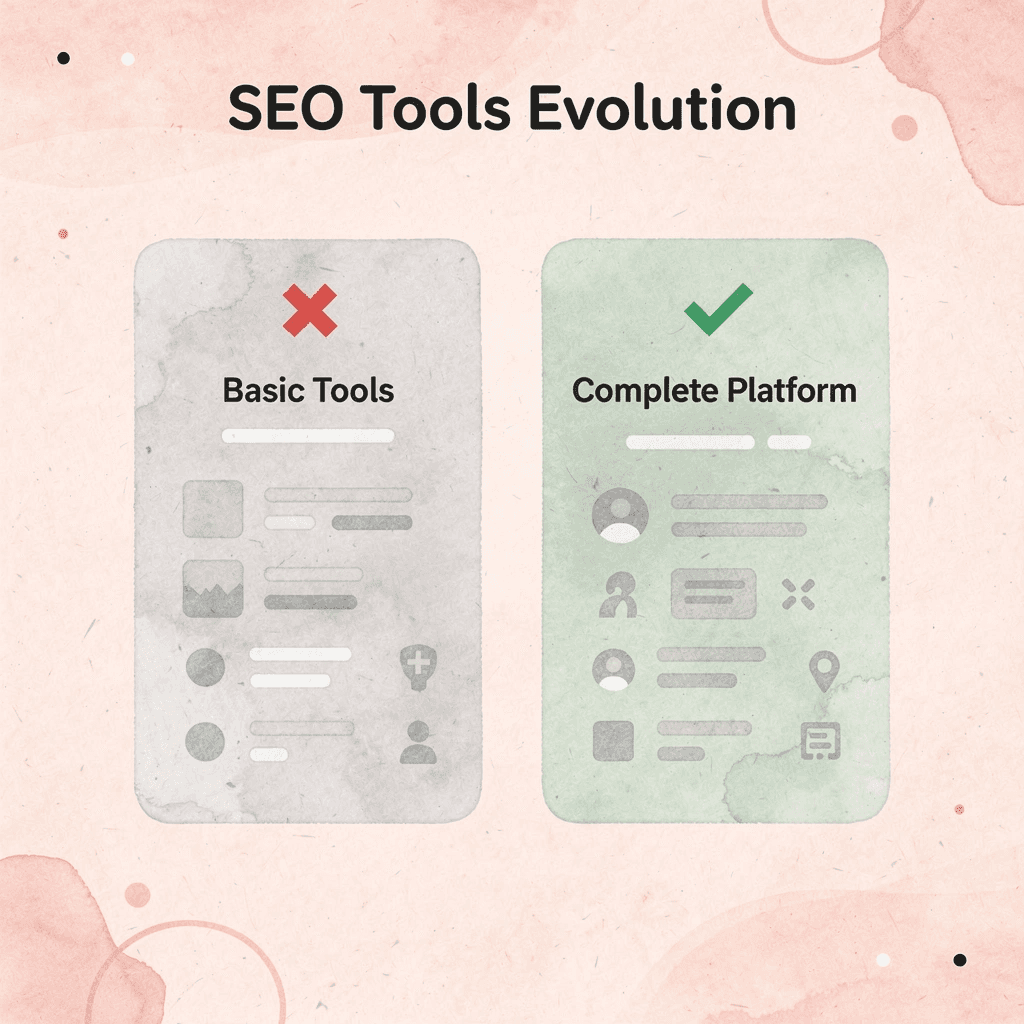
SEO agency software has changed dramatically. It now tracks keywords and analyzes backlinks while addressing operational challenges like client management, automated reporting, and workflow coordination. When teams spend more time wrestling with fragmented systems than delivering results, the bottleneck is operational infrastructure, not analysis capability.
🎯 Key Point: Modern SEO software success depends on operational efficiency, not analytical power alone.
"When teams spend more time wrestling with fragmented systems than delivering results, the bottleneck is operational infrastructure, not analysis capability." — Microsoft Work Trend Index
💡 Tip: Look for integrated platforms that combine SEO analysis with client management and automated reporting to eliminate workflow friction.
The Traditional SEO Tool Stack
Most agencies build workflows around tools designed for individual consultants, not teams managing multiple clients. Ahrefs tracks rankings, SEMrush audits technical issues, and Screaming Frog crawls site architecture. Each tool solves a specific analytical problem in isolation. You toggle between dashboards to check keyword positions, review backlinks, and export data for client reports.
How does tool fragmentation impact agency scaling?
That fragmentation creates friction that worsens as you grow. When clients experience dipping organic traffic from AI summaries and zero-click searches, traditional ranking reports fail to explain what's happening with their brand. You're left to manually assemble data from multiple sources, translate technical metrics into business outcomes, and reformat everything into client-friendly presentations.
What Agencies Actually Need to Scale
The constraint isn't access to data—it's the time spent converting that data into client communication, coordinating team workflows, and managing approval processes across dozens of accounts. Agencies need systems that handle operations: automated white-label reports that update without manual intervention, unified dashboards displaying all client performance in one place, and collaboration features that keep teams aligned without email chaos.
When managing 10 clients and posting 300 pieces of content monthly, the difference between success and burnout comes down to whether your tools handle repetitive work or force you to do it manually.
How do unified platforms streamline client management?
Platforms like rank number 1 on Google and AI search integrate reporting, client communication, and performance tracking into one workflow. Our solution automates the client management process from data collection through results delivery, freeing your team to focus on strategy rather than administrative tasks.
The Misconception Holding Agencies Back
The outdated belief is that SEO software means optimization tools. When proving ROI across traditional search and AI platforms like ChatGPT, Perplexity, and Gemini, analysis tools alone create scattered workflows and scaling limitations. The gap isn't in what you can measure—it's in how efficiently you can communicate that measurement to clients while managing your agency's other responsibilities.
What separates agencies that scale smoothly from those stuck in manual reporting overload isn't better keyword research. It's operational systems that treat client management, team collaboration, and performance tracking as connected workflows rather than separate tasks requiring different tools.
Related Reading
Professional Seo Agency
Technical Seo Agency
Top Seo Agency
Saas Seo Agency
Magento Seo Agency
15 Best SEO Agency Software in 2026
The tools agencies need in 2026 are systems that connect tracking what you can see, talking with clients, and money results across regular search and AI platforms. Ranking reports don't explain why a client's brand shows up in ChatGPT but not Perplexity, or why organic traffic dropped 30% despite Google positions remaining the same. The software that helps agencies grow addresses attribution, workflow coordination, and multi-platform visibility, not just keyword tracking.
"Organic traffic dropped 30% even though Google positions stayed the same—highlighting the gap between traditional ranking metrics and actual performance."
🔑 Key Takeaway: Modern SEO agencies need integrated platforms that track AI search visibility alongside traditional Google rankings to provide complete attribution analysis.
💡 Essential Insight: The software that helps agencies grow focuses on multi-platform visibility and workflow coordination rather than keyword tracking in 2026.

1. Visibility Trail
AI visibility tracking for agencies managing multi-platform search presence
Visibility Trail tracks brand mentions and visibility across AI search platforms like ChatGPT, Perplexity, and Google AI Overviews. It helps agencies demonstrate SEO value beyond traditional rankings, particularly when clients experience traffic drops despite maintaining their Google positions. The platform measures how often and how accurately AI tools mention your clients' brands when answering user questions.
Why it matters
AI platforms now handle billions of questions monthly, yet most agencies report only Google rankings. When 93% of online experiences begin with a search engine, and AI tools increasingly answer searches without sending traffic, visibility without attribution becomes invisible ROI. Clients need to understand where their brand appears in the AI-driven discovery process, not just traditional SERP rankings.
How it works
Visibility Trail monitors brand mentions across AI search results by running thousands of relevant queries through ChatGPT, Perplexity, and other AI tools, then tracking when and how your client's brand appears in responses. Reports show citation frequency, context accuracy, and competitive positioning across AI platforms, converting abstract "AI visibility" into measurable performance data for client reporting.
AI differentiation layer
The platform tracks AI search visibility, a metric that traditional rank trackers cannot measure. It monitors how AI tools describe your brand, what context they provide, and which competitors appear alongside it. This matters because AI citations don't follow ranking logic: a site can rank #1 on Google and never appear in ChatGPT responses, or rank #10 but dominate Perplexity citations.
Core capabilities
AI citation tracking that works across multiple platforms like ChatGPT, Perplexity, and Google AI Overviews
Automated testing of queries across different topic areas that report on citation frequency and accuracy.
Competitive visibility benchmarking and historical trend tracking for how your content appears in AI results
Proven impact
Real-time visibility data across multiple AI platforms
Automated reporting reduces manual query testing
Clear attribution metrics for client communication
Bottom line
Visibility Trail solves the measurement gap for agencies, proving SEO value in an AI-first search landscape by showing where client brands appear when users search through AI tools.
2. Trailblazer Marketing
SEO agency software for teams scaling organic growth across Google and AI search
Trailblazer Marketing is a Toronto-based platform helping agencies grow their organic reach across traditional search engines and AI platforms like ChatGPT, Perplexity, and Google AI Overviews. Built by founders who grew a marketplace to 100,000+ users through SEO alone, our platform treats search as a revenue driver. Our software connects rankings, content, and technical SEO directly to your sales pipeline and return on investment.
Why it matters
Most agencies optimize for Google rankings while clients lose traffic to AI-driven answer engines. This shift fragments visibility across multiple platforms, each requiring different optimization approaches. Our systems at Trailblazer Marketing handle both ranking optimization and AI citation tracking without forcing teams to manage separate workflows.
How it works
Trailblazer Marketing uses a product-led SEO framework built into its software. Top-of-funnel content focuses on scalable, answer-first formats like guides, FAQs, and glossaries. Bottom-of-funnel content targets high-converting landing pages optimized for service, industry, and intent-driven keywords. The platform maps content, traffic, and revenue across the full funnel, transforming SEO into a repeatable growth system.
AI search optimization is built in
The platform ensures your content appears in AI tools, not just Google. It helps AI bots (like GPTBot and PerplexityBot) find and read your content, organize information for direct answers, use schema and entity optimization, and track content authority and citation frequency. Ranking #1 on Google doesn't guarantee your brand will appear when ChatGPT answers the same question.
Core capabilities
Managing SEO campaigns for multiple clients, mapping content and keywords by funnel stage, tracking AI visibility across ChatGPT, Perplexity, and Google AI Overviews, handling technical SEO workflows and audits, building scalable content systems, tracking backlinks and authority, and connecting reports to leads, pipeline, and revenue.
Proven impact
845% organic growth driving $600K+ revenue, $1.8M generated in 12 months via SEO, 4.5x traffic growth yielding 3x revenue increase, and 100K+ users scaled through SEO.
Bottom line
Trailblazer Marketing replaces messy SEO workflows with a unified system built for rankings, AI visibility, and real revenue outcomes. It connects performance tracking directly to client business results, which is essential for agencies to prove ROI across traditional and AI search.
3. SE Ranking
Multi-project keyword tracking for agencies managing large client portfolios
SE Ranking works well for agencies managing multiple clients, offering unlimited projects with segmentation by region, language, or device from a single dashboard. SEO professionals can monitor rankings across different search engines and locations without switching tools.
Why it matters
Keeping track of keywords across many projects with region-specific monitoring and device-level segmentation becomes unwieldy when checking rankings manually. SE Ranking's bulk management tools and automated reporting help you manage large client portfolios without manual workarounds.
How it works
The platform organizes keywords and tracks rankings across unlimited projects with bulk imports and automated reporting. You can segment tracking by region, language, or device, then generate white-label reports branded for each client, eliminating manual data exports and streamlining oversight for large-scale, multi-site campaigns.
Core capabilities
Unlimited project and keyword tracking
Competitor analysis tool examining keyword strategies, traffic, and backlink profiles
Website audit module with prioritized technical SEO recommendations
Backlink monitoring: tracking new, lost, and toxic links
White-label reporting with automated delivery
Bulk keyword import and export options
Proven impact
Automated white-label reporting saves hours per client monthly, bulk keyword management handles thousands of terms across projects, and multi-project dashboards eliminate tool-switching overhead.
Bottom line
SE Ranking solves keyword tracking complexity for agencies managing multiple clients through region-specific, device-level rank monitoring. It automates manual data exports and report building.
4. WebCEO
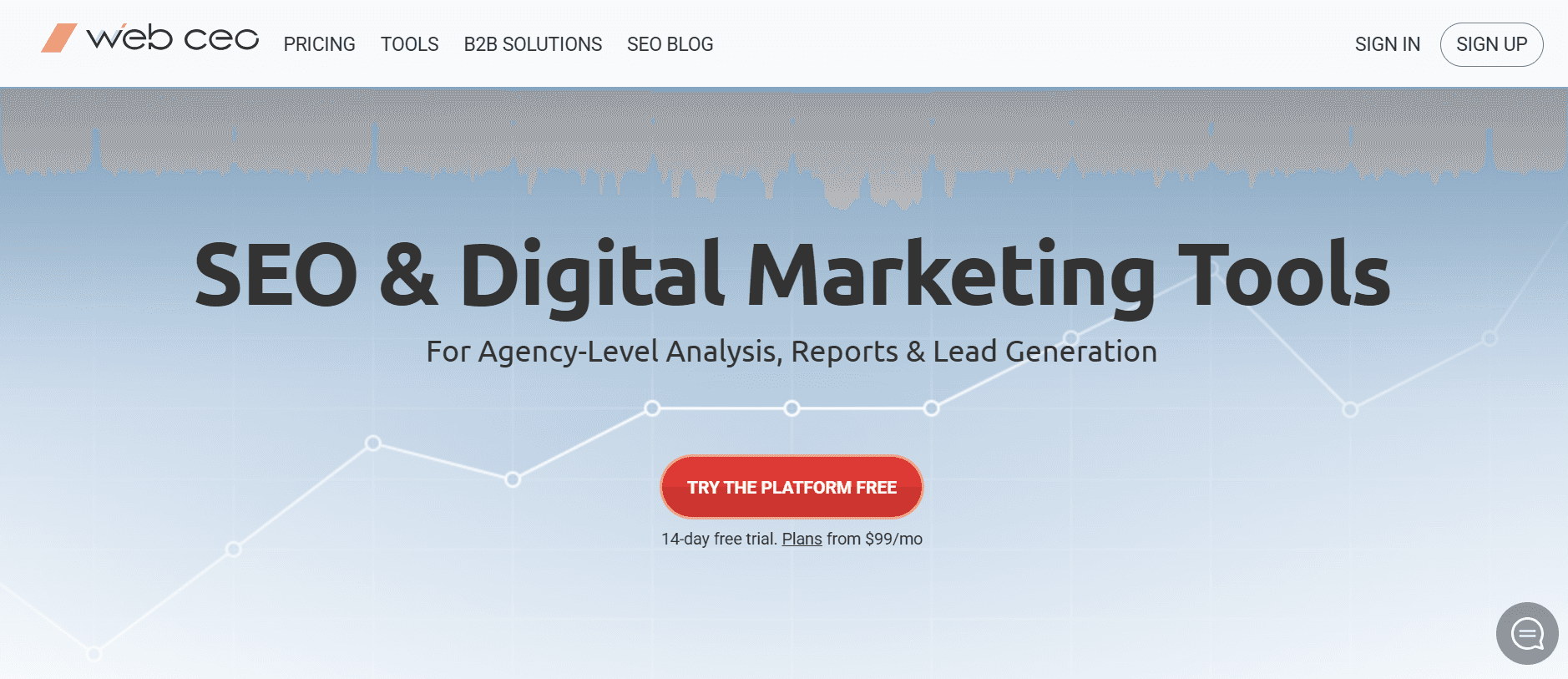
Client management features designed specifically for SEO agencies
WebCEO brings together project management and SEO analytics for agencies working with multiple clients. The platform offers client dashboards, white-label reporting, role assignment, and access controls to streamline workflows and improve client communication.
Why it matters
WebCEO's dedicated client dashboard lets teams organize projects, assign roles, and control access for each client account, which is critical for maintaining clear boundaries between projects and preventing confusion at the enterprise level.
How it works
The platform provides agencies with white-label reporting tools to deliver branded, automated reports to clients. You can track keyword positions across multiple search engines and locations, run SEO audits to identify technical issues, and monitor competitor activity. A task manager organizes SEO assignments by client across multiple accounts.
Core capabilities
Competitor analysis tool for keyword strategies, traffic, and backlink profiles
Website audit module with prioritized technical SEO recommendations
Backlink monitoring for new, lost, and toxic links
White-label reporting with automated delivery
Bulk keyword import and export options
Proven impact
Automated white-label reporting saves hours per client monthly
Bulk keyword management handles thousands of terms across projects
Multi-project dashboards eliminate tool-switching overhead
Bottom line
WebCEO helps agencies manage client communication, project organization, and SEO analysis in one platform. It's ideal if your team needs to maintain clear boundaries between client accounts while delivering branded reports.
5. Siteimprove
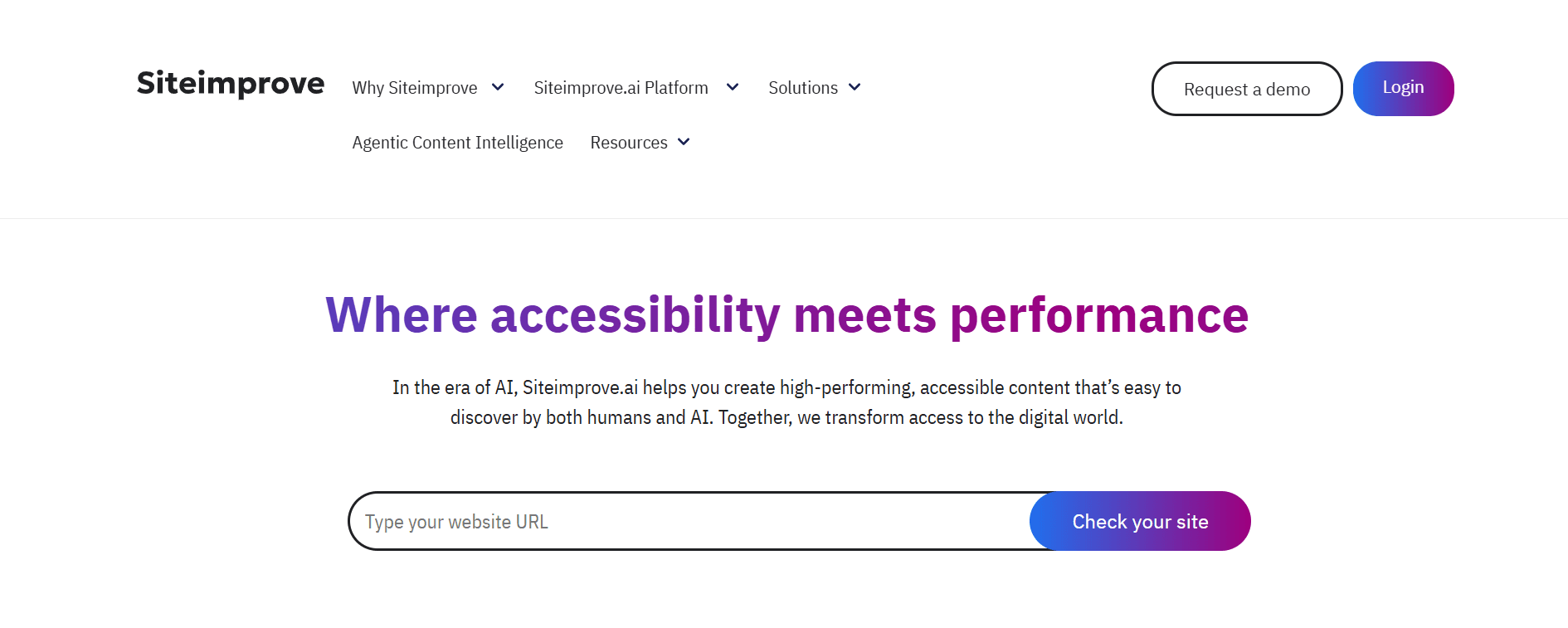
SEO analysis focused on compliance for regulated industries
Siteimprove is designed for organizations that need to balance SEO performance with strict digital compliance requirements. It's a strong fit for enterprise teams in regulated industries or public sectors, where accessibility, data privacy, and policy adherence matter as much as search visibility. The platform combines SEO analysis with automated compliance checks to help agencies manage risk while optimizing large, complex sites.
Why it matters
For agencies working with regulated industries, compliance violations pose legal and financial risks that outweigh the benefits of ranking improvements. WCAG accessibility standards and GDPR compliance requirements aren't optional, yet most SEO tools ignore them entirely. Siteimprove addresses both search performance and legal requirements within a single workflow, enabling enterprise teams to manage risk across large, multi-site environments.
How it works
The platform combines technical SEO auditing with automated accessibility and data privacy checks. It scans for broken links, misspellings, and outdated information, and flags WCAG accessibility and GDPR compliance issues. The SEO scorecard benchmarks performance across domains, and policy management enforces brand, legal, and editorial guidelines across web properties.
Core capabilities
Content quality assurance for broken links, misspellings, and outdated information
SEO scorecard tracking across multiple domains
Policy management for brand, legal, and editorial guidelines
Automated reporting for SEO and compliance metrics
Multi-domain SEO scorecard tracking
Proven impact
Built-in policy management enforces content governance
Automated accessibility checks ensure WCAG compliance
Multi-domain scorecard tracking maintains standards across properties
Bottom line
Siteimprove helps agencies managing clients in regulated industries close the compliance gap by addressing both search performance and legal compliance in one platform.
6. Sitechecker
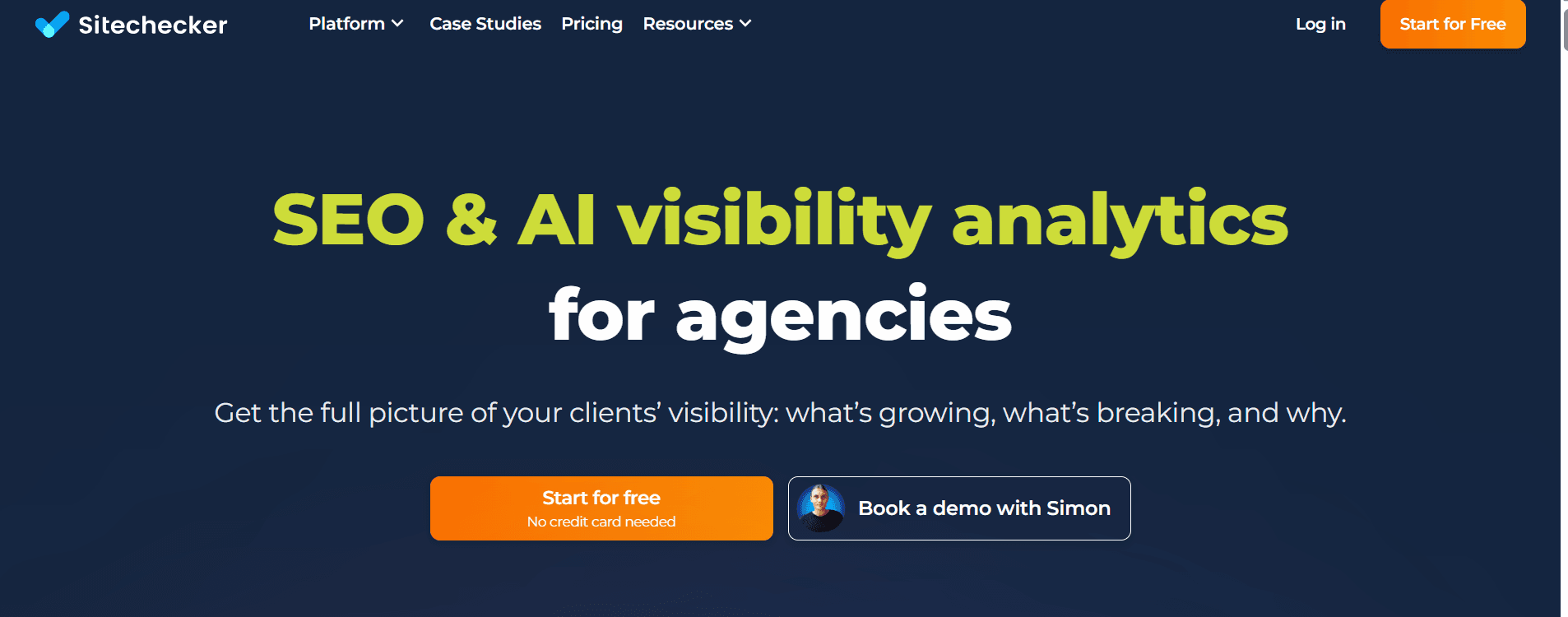
Real-time rank tracking for agencies managing high-volume campaigns
Sitechecker serves agencies and in-house SEO teams requiring current keyword ranking data across multiple projects. Its real-time tracking suits professionals managing high-volume campaigns, where visibility shifts demand and quick responses are required, offering specialized SERP monitoring capabilities.
Why it matters
Most rank trackers update daily or weekly, creating blind spots when rankings shift rapidly from algorithm updates or competitive changes. Real-time tracking enables agencies managing multiple clients to react quickly to SERP changes without waiting for scheduled updates.
How it works
Sitechecker tracks keyword positions via live dashboards with instant notifications for ranking changes. The platform runs site audits to identify technical SEO issues, monitors new and lost backlinks daily, analyzes pages for improvement opportunities, and generates white-label reports for client sharing.
Core capabilities
Real-time keyword rank updates for all projects
Site audit tool with prioritized technical recommendations
Backlink monitoring with daily updates
On-page SEO checker for individual URLs
White-label reporting with custom branding
Bulk site audits for multiple domains
Proven impact
Real-time rank updates eliminate the need to wait for scheduled refreshes.
The on-page SEO checker provides URL-specific optimization guidance.
Bulk site audits handle multiple domains simultaneously.
Bottom line
Sitechecker solves the delay problem for agencies that need to track ranks across multiple campaigns. It provides live visibility so teams can respond to ranking changes without waiting for daily updates.
7. BrightEdge
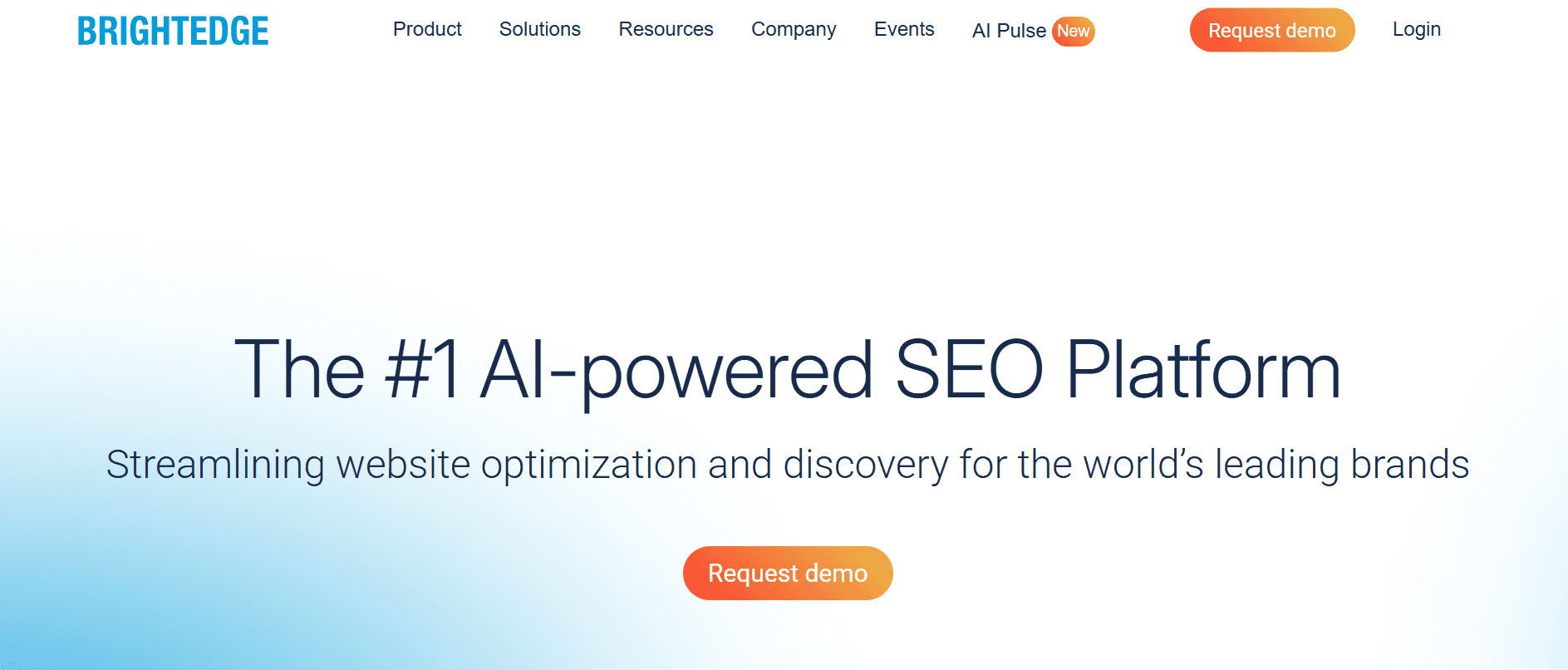
Unified content and SEO workflows for enterprise campaigns
BrightEdge brings together content and SEO workflows in a single platform for agencies managing complex, multi-site campaigns. It suits teams coordinating content strategy, technical SEO, and performance tracking at scale, aligning content creation with search opportunities and automating reporting across large client portfolios.
Why it matters
Most agencies manage content strategy and SEO in separate tools, creating coordination gaps. When content teams miss keyword opportunities, and SEO teams cannot track performance, campaigns lose efficiency. BrightEdge connects keyword research, content recommendations, and performance analytics in one platform, eliminating tool switching.
How it works
The platform's Data Cube provides access to a large, regularly updated keyword and content database for deep research and opportunity analysis. StoryBuilder creates custom dashboards and automated reports tailored to specific clients or campaigns. The Recommendations Engine delivers prioritized, actionable SEO recommendations based on real-time site and competitor data. Share of Voice tracking monitors your brand's visibility against competitors across multiple search engines and regions.
Core capabilities
Deep keyword and competitor research database
Automated, customizable reporting for multiple clients
Unified platform for content and SEO workflows
Data Cube for keyword and content opportunity analysis
StoryBuilder for custom dashboards and reports
Recommendations Engine for prioritized SEO tasks
Share of Voice tracking across search engines
Proven impact
Automated reporting eliminates manual data compilation.
Content recommendations show SEO opportunities immediately.
Share of Voice tracking compares your visibility against competitors.
Bottom line
BrightEdge solves the coordination gap for agencies managing enterprise-level campaigns by bringing together content and SEO teams around shared data and workflows.
8. Moz
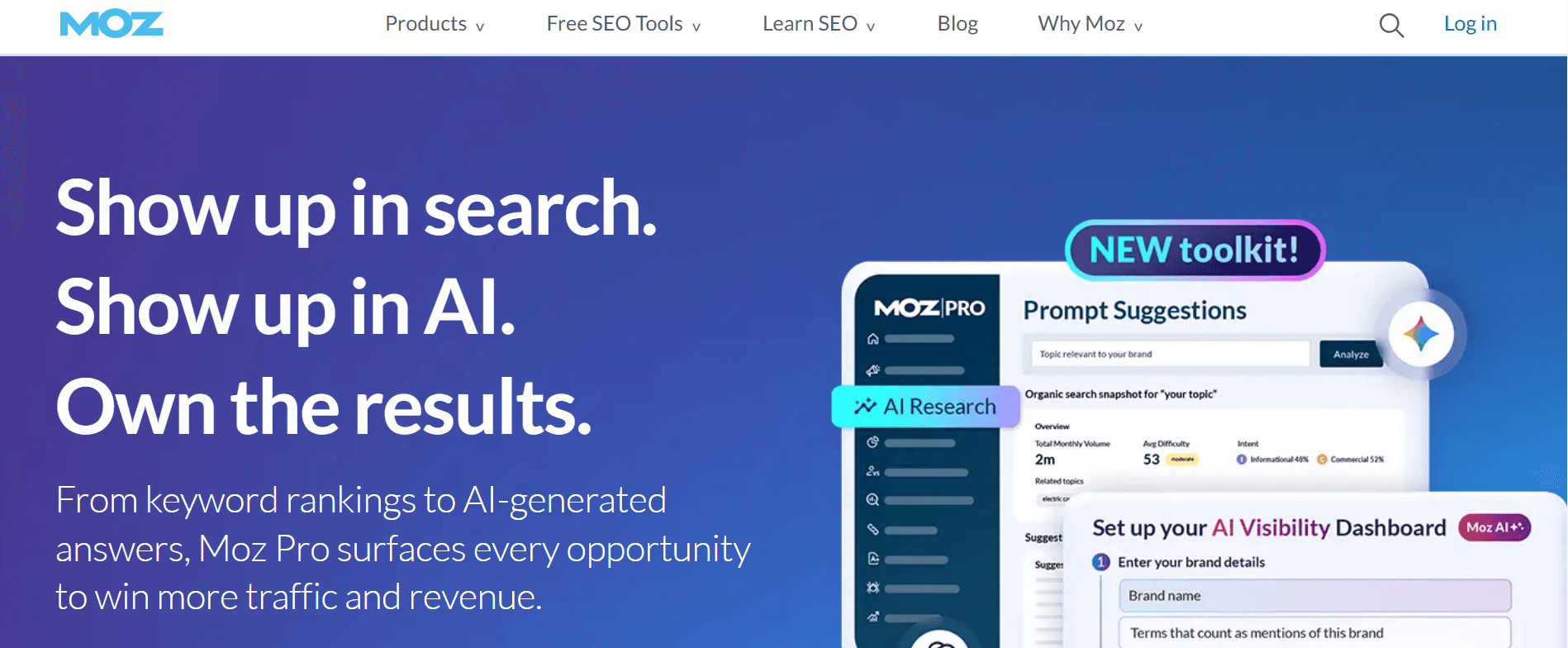
Intuitive link analysis tools for competitive research
Moz stands out for agencies and in-house SEO teams needing clear, actionable link analysis. Its intuitive interface and proprietary metrics, such as Domain Authority, help marketers assess backlink quality and identify link-building opportunities, making it particularly useful for competitive research and monitoring link profiles at scale.
Why it matters
Looking at thousands of incoming links across multiple websites requires the right tools to manage effectively. Most backlink platforms provide raw data without sufficient context, requiring manual quality checks. Moz's proprietary metrics, such as Domain Authority and Spam Score, enable teams to quickly evaluate link quality and make data-driven link-building decisions.
How it works
Link Explorer provides detailed information about inbound links, anchor text, and linking domains, which is essential for agencies managing multiple client portfolios. Keyword research includes suggestions, SERP analysis, and difficulty scores. Site crawls identify technical SEO issues and deliver prioritized recommendations. Rank tracking monitors keyword positions across multiple search engines and locations.
Core capabilities
Link Explorer for detailed backlink analysis
Domain Authority and Spam Score for link quality evaluation
Keyword Explorer with SERP analysis and difficulty scores
Site Crawl with technical SEO recommendations
Rank Tracking across multiple search engines
On-Page Grader for optimization opportunities
Proven impact
Domain Authority provides a trusted way to assess link quality.
Spam Score warns about risky incoming links before they cause trouble.
Rank tracking monitors your website across multiple search engines, giving you a complete picture of your performance.
Bottom line
Moz simplifies link analysis for agencies by providing tools to assess backlink quality, identify opportunities to build links from competitors, and plan link-building strategies with actionable data and insights.
9. Botify
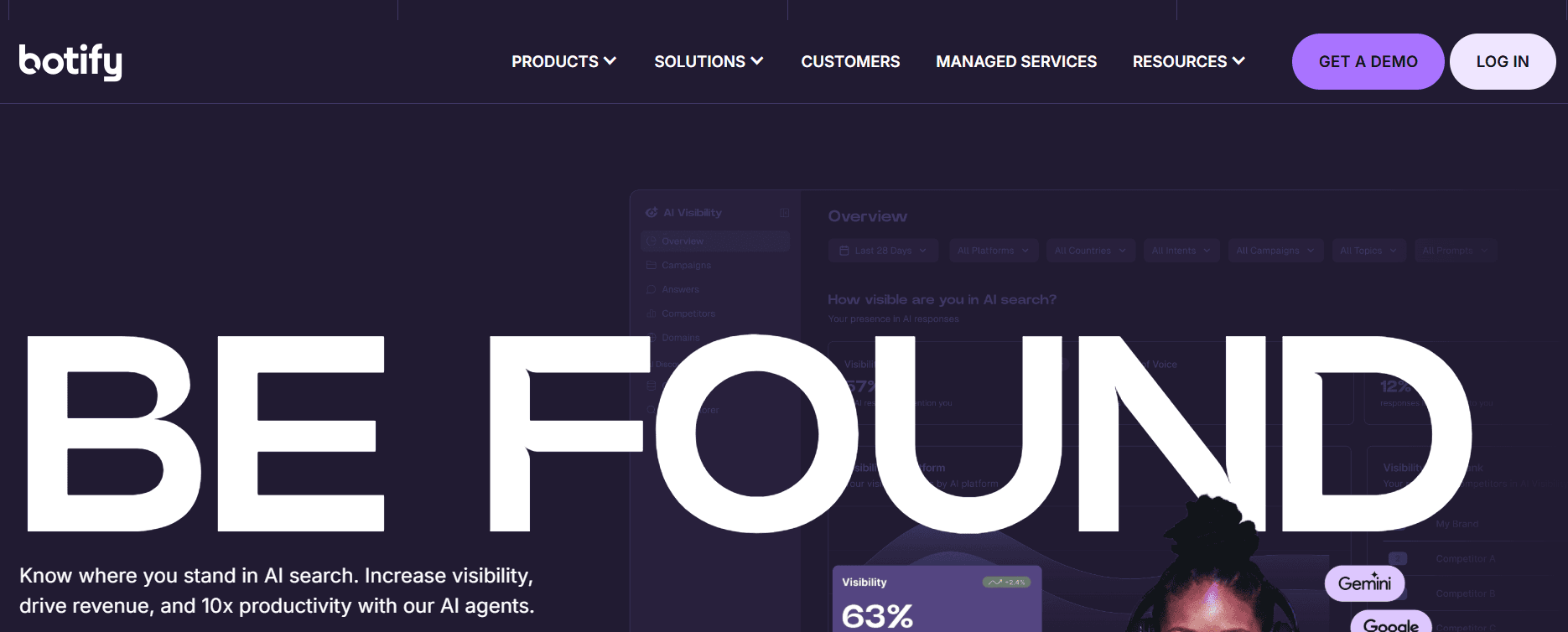
Large-scale crawl management for massive websites
Botify offers advanced crawl management and analytics for enterprise SEO teams managing millions of URLs. Built for ecommerce, media, and marketplace businesses with complex site architectures, it helps technical SEO leads uncover crawl-budget issues, prioritize fixes, and ensure that search engines index the most valuable content.
Why it matters
Managing large-scale crawl operations presents a unique challenge in enterprise SEO. Sites with millions of URLs face crawl budget problems where search engines waste resources on low-value pages while missing important content. Botify's log file analysis and customizable crawl settings help technical SEO teams identify where search engines waste resources and make data-driven decisions about site structure and content prioritization.
How it works
The platform analyzes millions of URLs to identify crawl-budget issues using log file analysis. RealKeywords connects organic search traffic to specific keywords and landing pages. Botify Analytics provides site health dashboards and customizable reporting. ActionBoard surfaces prioritized SEO tasks based on real-time data. JavaScript crawling renders dynamic sites to uncover hidden SEO issues.
Core capabilities
Handles millions of URLs per crawl
Log file analysis for crawl budget insights
JavaScript rendering for dynamic site analysis
RealKeywords for traffic-to-keyword connection
Botify Analytics for site health dashboards
ActionBoard for prioritized SEO tasks
Proven impact
Log file analysis identifies crawl budget waste
JavaScript rendering uncovers issues on dynamic sites
Handles millions of URLs without performance degradation
Bottom line
Botify helps agencies manage crawling problems for large websites with millions of web pages. It provides tools for enterprise-level technical SEO and optimizes crawl-budget allocation.
10. Conductor
Large-scale SEO optimization for enterprise websites and agencies
Conductor is built for teams managing large, complex websites that need structured SEO execution across thousands of pages. Enterprise SEO requires coordinating improvements across large sets of pages rather than isolated optimizations.
Why it matters
Conductor helps teams identify high-impact opportunities across large domains and prioritize execution based on search performance and content gaps, turning overwhelming SEO data into structured, actionable workflows.
How it works
Conductor continuously analyses site performance, keyword data, and content opportunities across large websites. Its Explorer tool supports keyword and topic research, Content Guidance provides on-page optimization recommendations, workflow tools assign tasks and track team progress, and Insight Stream surfaces real-time SEO opportunities.
Core capabilities
Large-scale site auditing and optimization
Keyword tracking at enterprise volume
Content optimization recommendations
Workflow and team collaboration tools
Keyword and topic research (Explorer)
SEO insight and opportunity feed (Insight Stream)
Proven impact
Improves visibility across large, multi-page domains
Helps teams prioritize high-impact SEO fixes
Streamlines collaboration across enterprise SEO teams
Bottom line
Conductor is best for enterprise teams that need structure, collaboration, and scalability across complex SEO programs.
11. seoClarity
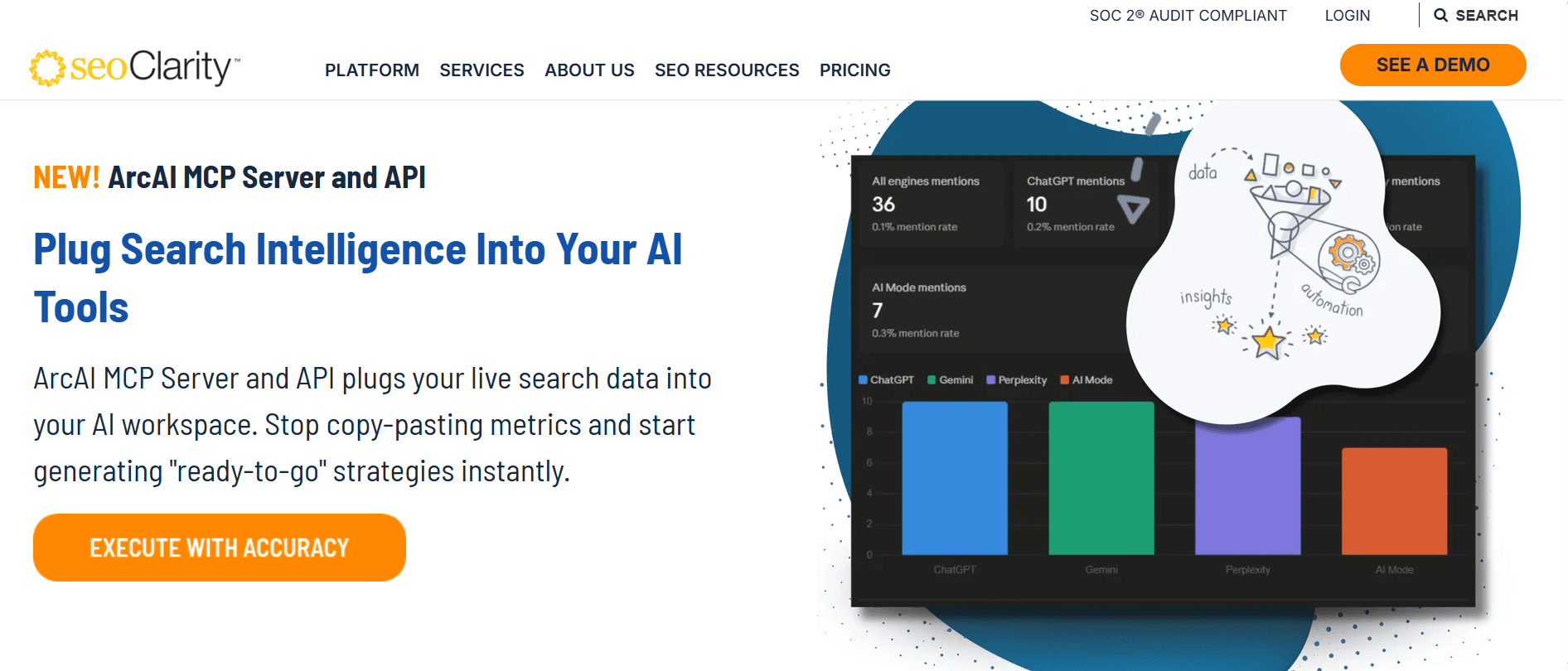
Custom SEO reporting and analytics for enterprise teams
seoClarity is designed for agencies and enterprise SEO teams that need full control over reporting, dashboards, and data visualization for multiple clients or business units.
Why it matters
Enterprise SEO often fails at the reporting layer: data exists, but it's not usable. seoClarity solves this by allowing teams to build fully customized dashboards aligned with specific KPIs, workflows, and stakeholder needs.
How it works
seoClarity brings together keyword, content, and technical SEO data into customizable dashboards. Its Clarity Grid enables large teams to analyze data across keywords and pages, while Content Fusion uses AI to create optimized content briefs. Rank Intelligence tracks keyword performance at scale with historical insights.
Core capabilities
Fully customizable SEO dashboards
AI-powered content optimization (Content Fusion)
Large-scale keyword tracking and segmentation
Technical site auditing tools
Competitive keyword analysis (Clarity Grid)
Proven impact
Enables real-time SEO reporting across enterprise teams and reduces manual reporting workload through automation.
Improves visibility into keyword and content performance
Bottom line
seoClarity is best for agencies needing highly customizable, enterprise-grade SEO reporting and analytics.
12. Lumar
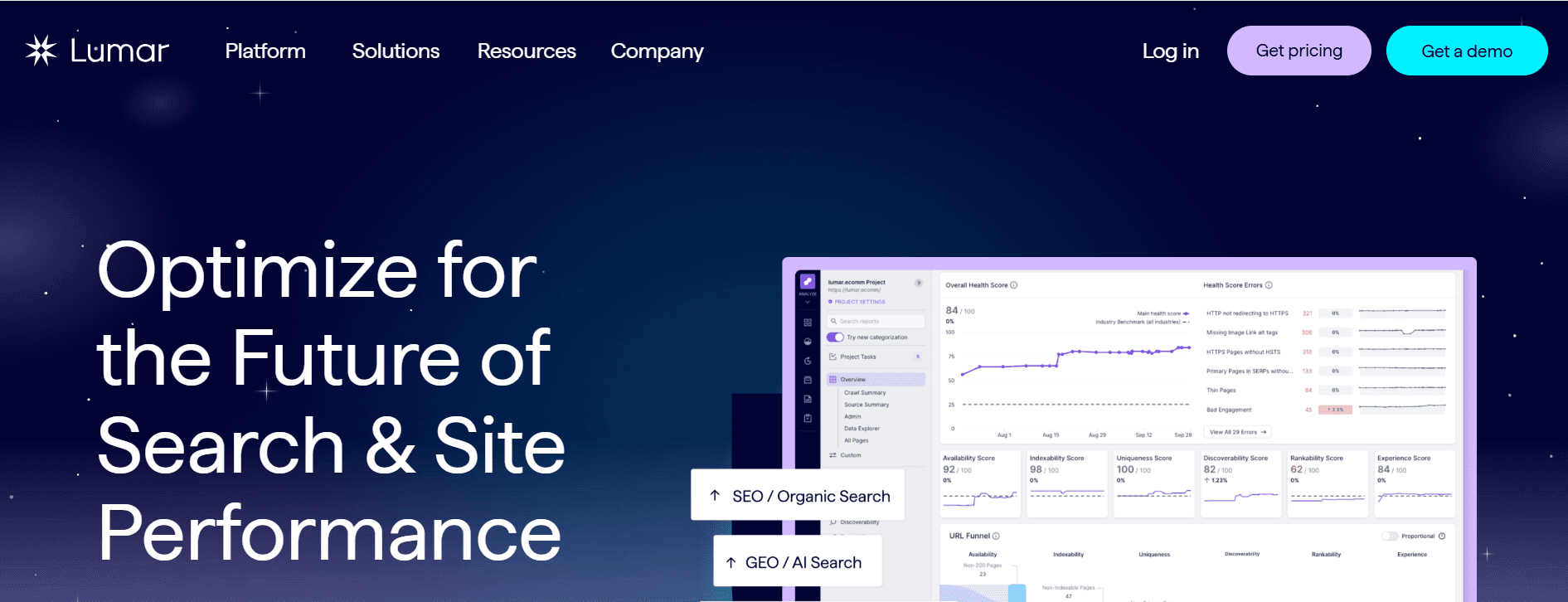
Technical SEO and site health monitoring for complex websites
Lumar is a technical SEO platform for enterprise websites where technical performance directly impacts indexing, rankings, and user experience. Large websites often have hidden technical issues: crawl errors, broken structures, and indexing inefficiencies. Lumar helps SEO teams find and prioritize these issues before they affect search visibility.
How it works
Lumar crawls websites and analyzes technical performance using customizable diagnostics and health scoring. It tracks changes over time, identifies regressions, and supports JavaScript rendering for modern web applications. Teams can extract custom data points and set up alerts for critical issues.
Core capabilities
Technical site health monitoring at scale
JavaScript rendering for dynamic websites
Custom data extraction rules
Automated health scoring and prioritization
Change tracking and issue alerts
Proven impact
Identifies critical technical SEO issues early
Improves indexing and crawl efficiency
Supports enterprise-scale technical site audits
Bottom line
Lumar is best for technical SEO teams managing complex websites that require continuous monitoring and deep crawl diagnostics.
13. Semrush

All-in-one SEO platform for research, competitor analysis, and execution
Semrush is a comprehensive SEO toolkit for keyword research, competitor analysis, backlink tracking, and site audits. It consolidates multiple SEO workflows into a single platform, making it popular among agencies and marketers.
How it works
SEO execution depends on quickly identifying opportunities. Semrush helps teams find low-competition keywords, analyze competitors' strategies, and uncover backlink opportunities to copy or improve.
Users can find ranking opportunities through Organic Research, discover keyword gaps between competitors, and analyze backlink profiles. The platform includes site audits and keyword difficulty filtering to prioritize SEO efforts.
Core capabilities
Keyword research and opportunity discovery
Competitor keyword gap analysis
Backlink gap and backlink analytics
Site audits and technical SEO checks
Rank tracking and visibility monitoring
Proven impact
Identifies high-opportunity, low-difficulty keywords
Reveals competitor backlink strategies
Supports full-funnel SEO strategy development
Bottom line
Semrush is best for teams that want an all-in-one SEO platform for research, competitive intelligence, and execution.
14. Rankability
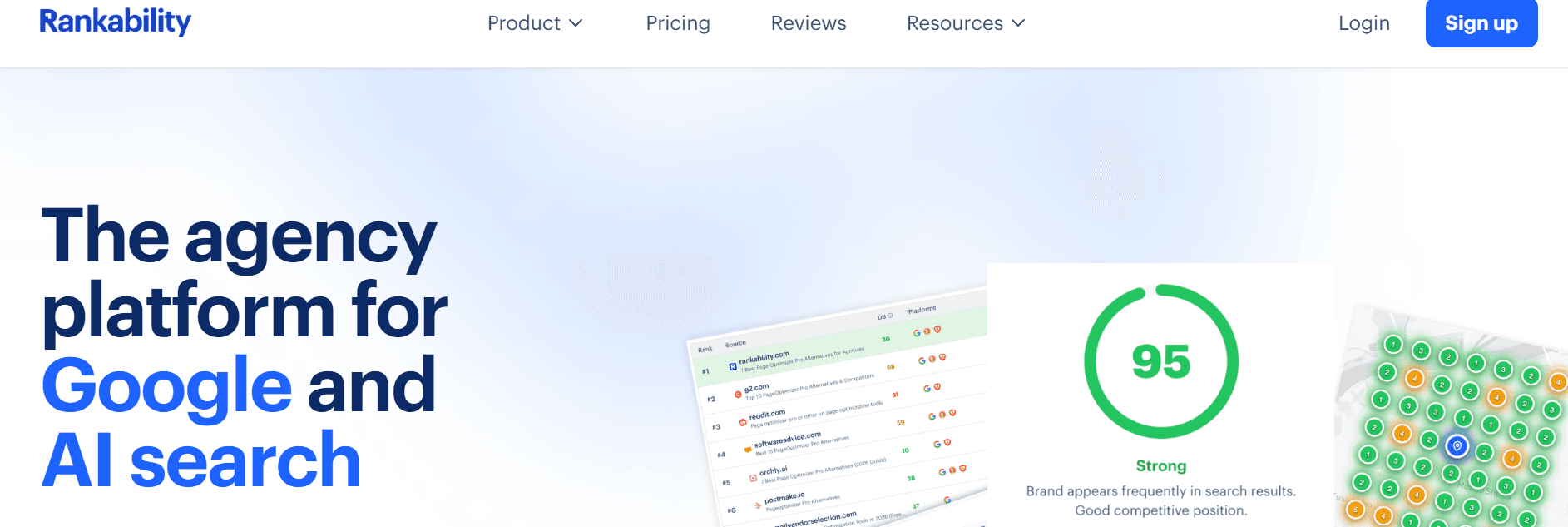
AI-powered content optimization and SEO brief creation tool
Rankability is a content optimization platform designed to help teams create highly optimized SEO content using NLP-driven insights. It focuses heavily on improving content briefs and ensuring writers produce search-optimized articles from the start.
Why it matters
Most SEO content fails before it’s written — due to weak briefs. Rankability solves this by generating structured, NLP-informed content outlines that guide writers toward higher-ranking content from the beginning.
How it works
Users generate SEO content briefs using either manual inputs or AI assistance. The platform then builds structured outlines based on NLP keyword analysis. The content optimizer provides real-time recommendations as you write, ensuring alignment with search intent and semantic relevance.
Core capabilities
AI-generated SEO content briefs
NLP-based keyword optimization
Structured content outlining tools
Real-time content optimization feedback
Writing workflow integration
Proven impact
Improves content quality and search relevance
Reduces content production inefficiencies
Helps teams create more consistent SEO outputs
Bottom line
Rankability is best for teams focused on scaling high-quality SEO content using structured, AI-assisted workflows.
15. ChatGPT
AI-powered research, analysis, and SEO strategy tool
ChatGPT is a general-purpose AI tool that has become an essential part of modern SEO workflows. It is widely used for content ideation, keyword clustering, data analysis, and strategic SEO planning.
Why it matters
SEO teams increasingly rely on AI not just for writing content, but for analyzing data, generating insights, and accelerating decision-making. ChatGPT can process large datasets, identify patterns, and support strategic SEO analysis beyond what traditional tools can.
How it works
Users can input keyword lists, SERP data, or content ideas, and ChatGPT can cluster topics, analyze patterns, and generate SEO strategies. It is also used for content drafting, optimization suggestions, and the synthesis of competitive research.
Core capabilities
Keyword clustering and topic grouping
SEO content ideation and outlining
SERP data analysis and interpretation
Content optimization suggestions
Strategic SEO planning support
Proven impact
Accelerates SEO research and planning workflows
Helps analyze large datasets for insights
Supports scalable content strategy development
Bottom line
ChatGPT is best for SEO teams looking to accelerate research, strategy, and content workflows with AI-driven analysis.
Related Reading
Fintech Seo
Generative Engine Optimization Agency
Hotel Seo Agency
Contractor Seo Agency
Dentist Seo Agency
Best Content Marketing Agencies
Ethical Seo Agency
Seo Content Writing Agency
Award Winning Seo Agency
Travel Seo Agency
Automotive Seo Agency
Seo Agency For Startups
Hospitality Seo Agency
Seo Agency For Software Companies
Mobile Seo Agency
Tech Seo Agency
Stop Relying on SEO Tools Alone — Validate What Actually Works
Tools analyze, track, and report, but they don't create rankings, traffic, or revenue. Execution and strategy drive results, not software alone.

Most teams subscribe to rank trackers, audit platforms, and content analyzers, then expect performance to follow. But data without disciplined execution creates a different problem: you know what needs fixing, yet fixes don't happen fast enough. You spot keyword opportunities, but content production can't keep pace. You track rankings, but can't prove which efforts actually moved revenue.
Trailblazer Marketing created the $300 Validate Program to test a complete SEO system, including product-led keyword research, high-velocity content production, and performance tracking with 10 fully optimized articles delivered in 30 days. A B2C SaaS company achieved 3,518% growth in non-branded traffic in 21 days, translating to over 2.1 million organic clicks and $700,000+ in first-year revenue. Other campaigns have delivered 9,000%+ growth within 10 months by focusing on execution rather than tooling.

🎯 Key Point: You don't need more SEO software—you need proof that your SEO strategy works. Reserve your spot in the $300 Validate Program today. You'll get onboarding, 10 SEO-optimized articles, and a 30-day performance report with no long-term commitment. Only 3 spots are available each month.
"A B2C SaaS company saw 3,518% growth in non-branded traffic in 21 days, translating into over 2.1 million organic clicks and $700,000+ in first-year revenue." — Trailblazer Marketing Case Study
🔑 Takeaway: The gap between SEO analysis and actual results comes down to execution speed and strategic focus. Tools provide the roadmap, but disciplined implementation delivers the revenue.
Related Reading
Best Ecommerce Seo Agency
Best Searchgpt Seo Agency
Hire Seo Agency
Seo Agency For Accountants
Plumber Seo Agency
Technical Seo Agencies
Real Estate Seo Agency
Fintech Seo Agency
How to Do Programmatic SEO for Scalable Search Traffic Growth
Learn how Programmatic SEO helps scale content creation and grow search traffic through automated, keyword-focused pages.
15 Best B2B Marketing Agency Options for Scaling Demand Generation
Compare top firms in this list of 15 best B2B marketing agencies and find the right Search Engine Optimization Services Agency for scaling demand generation.
Top 12 B2B Content Marketing Strategies for AI-Driven Search
B2B Content Marketing strategies for AI-driven search that improve visibility, relevance, and lead generation in evolving search environments.

Used to help top companies: